
Bug reports & feedback
Report a bug. Share feedback. Suggest a feature.
Tell me what went wrong, what could be clearer, or what you would like CogniTrack to do next. It lands directly in my admin console — no public board, no ticket queue.

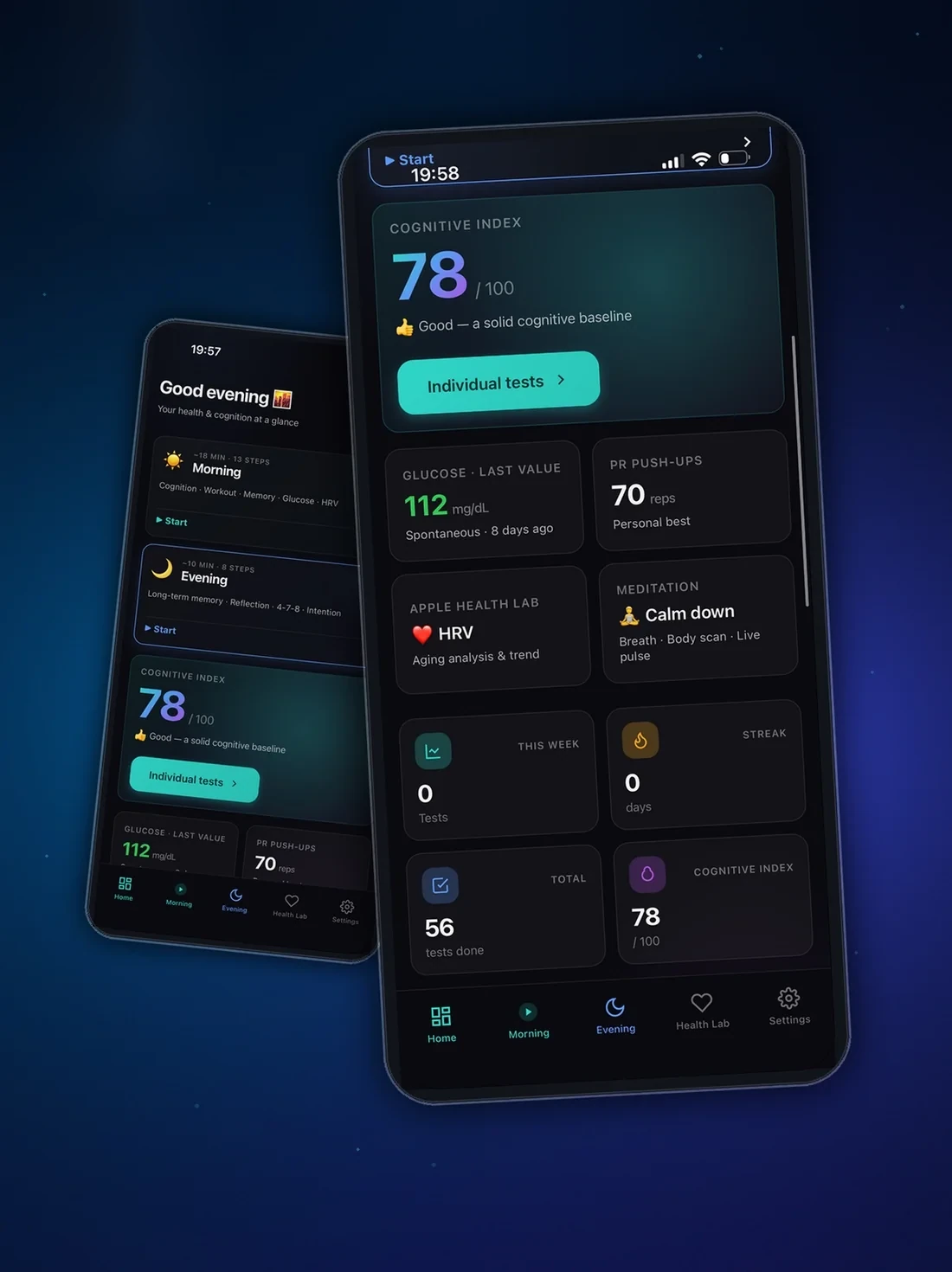
Seven minutes every morning: memory, attention, reaction time. CogniTrack turns that into your own baseline and reads it next to your sleep, HRV and recovery. On your iPhone. Nowhere else.

Why now
Tools got faster. Feeds got louder. Your attention and working memory are still running on the hardware you were born with — and that hardware is now the bottleneck. CogniTrack gives you a way to see yours: one fixed protocol, your own baseline, and the recovery context around it.
Some days you feel slower. The same test, run the same way, tells you whether that’s a mood or a pattern.
Athletes don’t guess. They measure, then train. CogniTrack applies the same loop to attention and memory.
Short tasks built on established paradigms — N-Back, Stroop, SART. No coins, no streak confetti.
A year of ordinary days beats one perfect test. Follow your own line, and notice what moves it.
Same principle
DRFRIEDELS started with pocket multi-tools — the right thing to hand at the moment you actually need it. CogniTrack is the software version: one app for the daily loop, instead of a sleep tracker, a brain-game app and a spreadsheet that never speak to each other.
Why I built it
I started in bioinformatics — teaching machines to find the signal in messy biological data. Two decades later the job titles have changed a lot and the mission hasn’t: build tools people can actually use.
At some point it got personal. I care about longevity — not the supplement-stack kind, the boring kind. And the research keeps pointing the same way: there is no hack. What compounds is routine. Measure the right things, train consistently, learn from your own patterns.
My own data was scattered across a dozen apps. Sleep here, HRV there, a brain-training game that talked to none of it. Nothing connected mind and body — even though anyone who has slept four hours knows they are connected.
So I built it. I set the direction and read the literature; AI agents wrote most of the code. The tasks are the ones with real pedigree in cognitive science. Morning and evening routines to bookend the day. Plain language instead of raw charts. And one rule I wouldn’t trade away: the data stays on your phone.
CogniTrack is the tool I wanted and couldn’t buy. If routine is the lever, this is the handle.
Inside the app
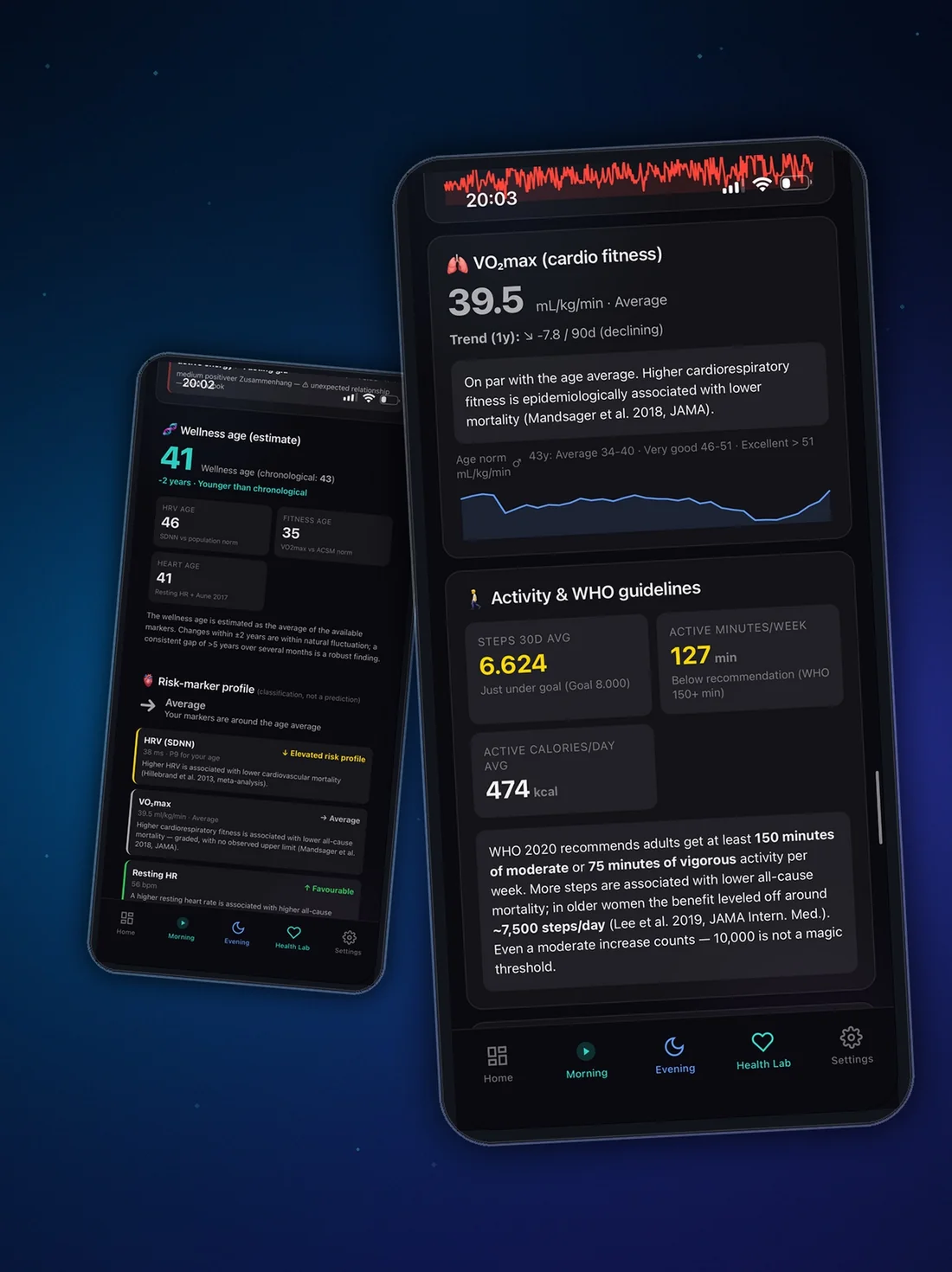
A protocol you can repeat, a baseline you can trust, the health signals you already wear, and the links between them.
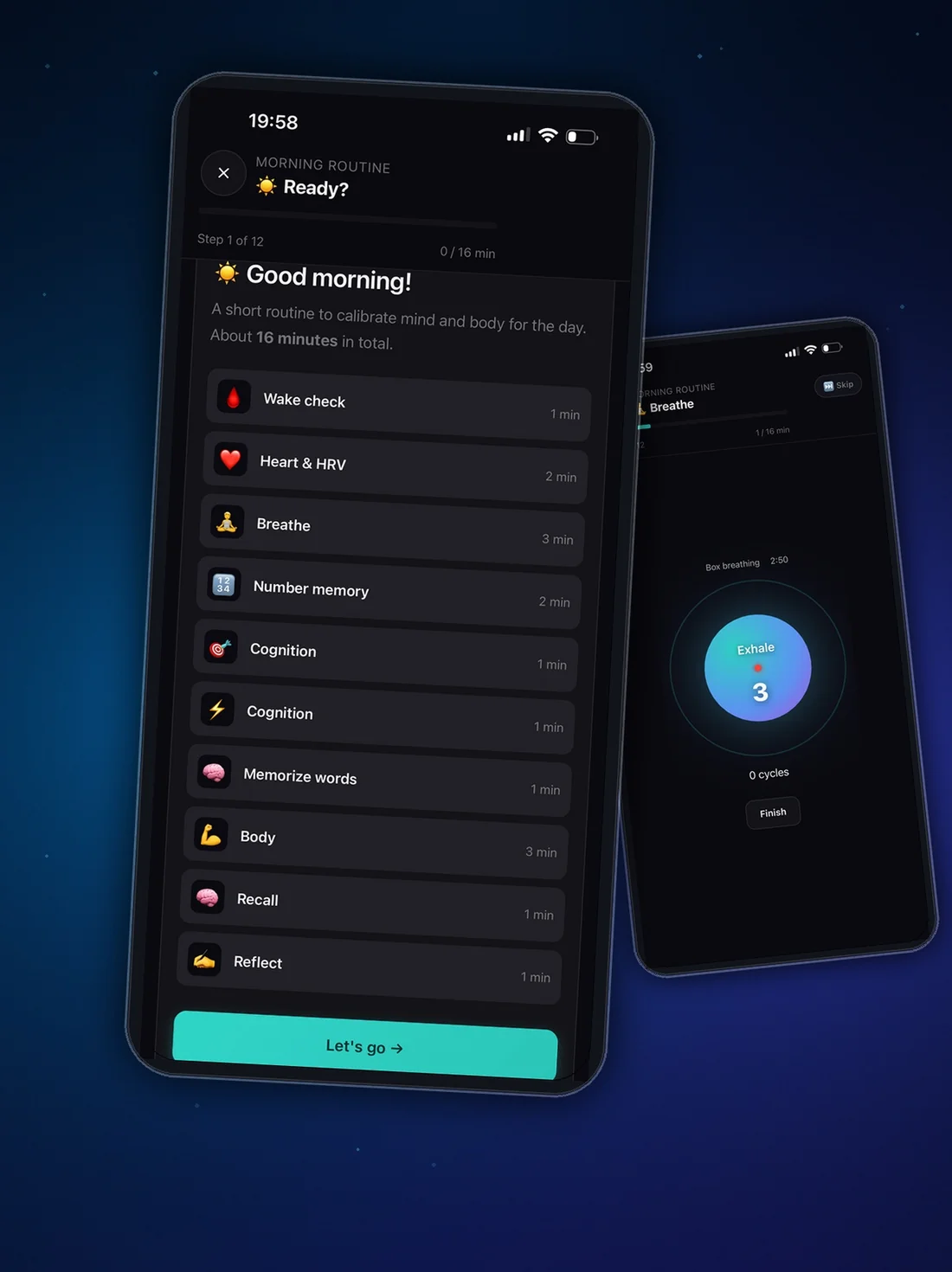
Daily routine
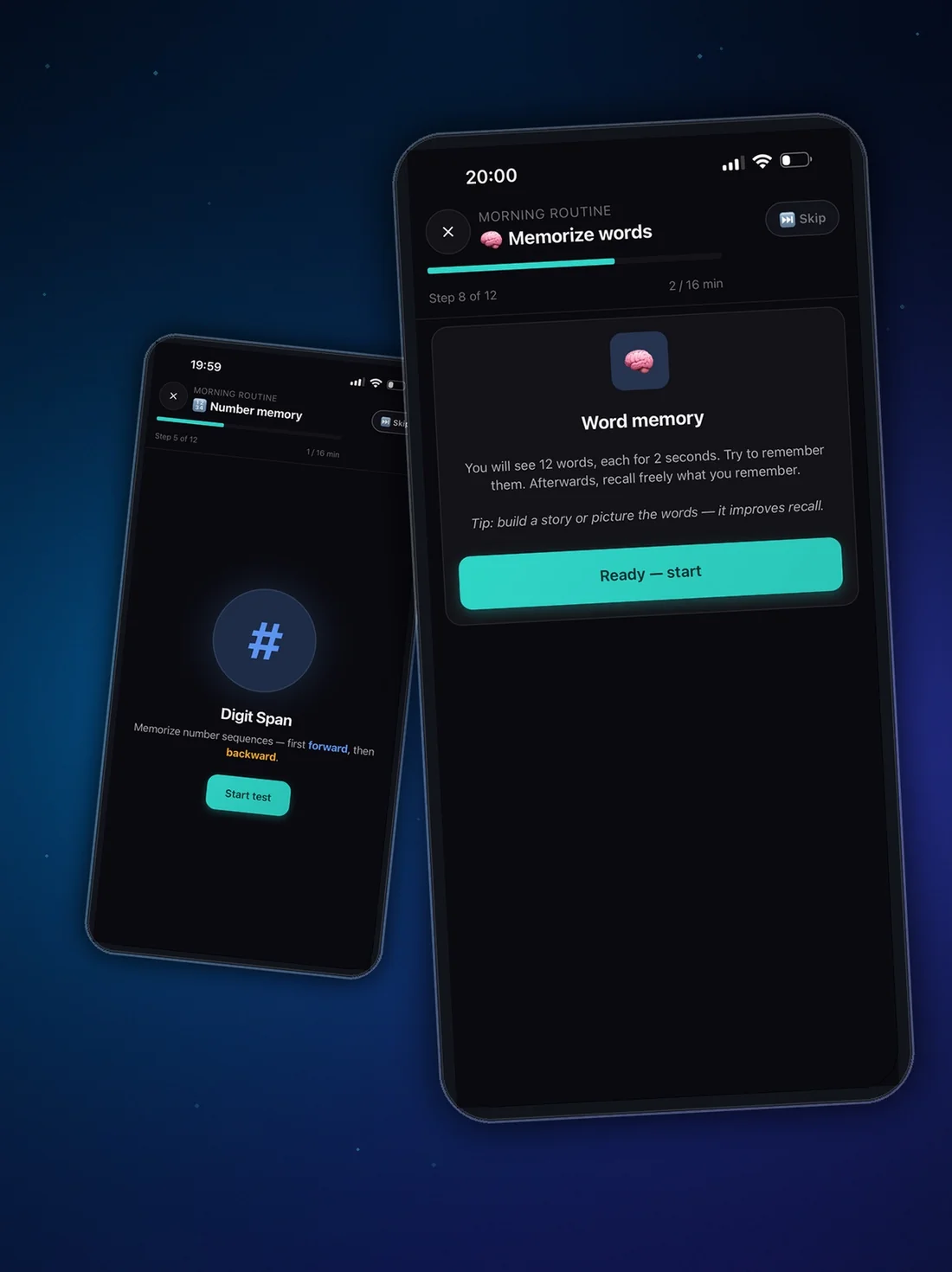
The morning core is fixed on purpose — same tasks, same order, same time of day. That is what makes yesterday and today comparable. The evening close is short: recall, wind down, set tomorrow.
Measurement
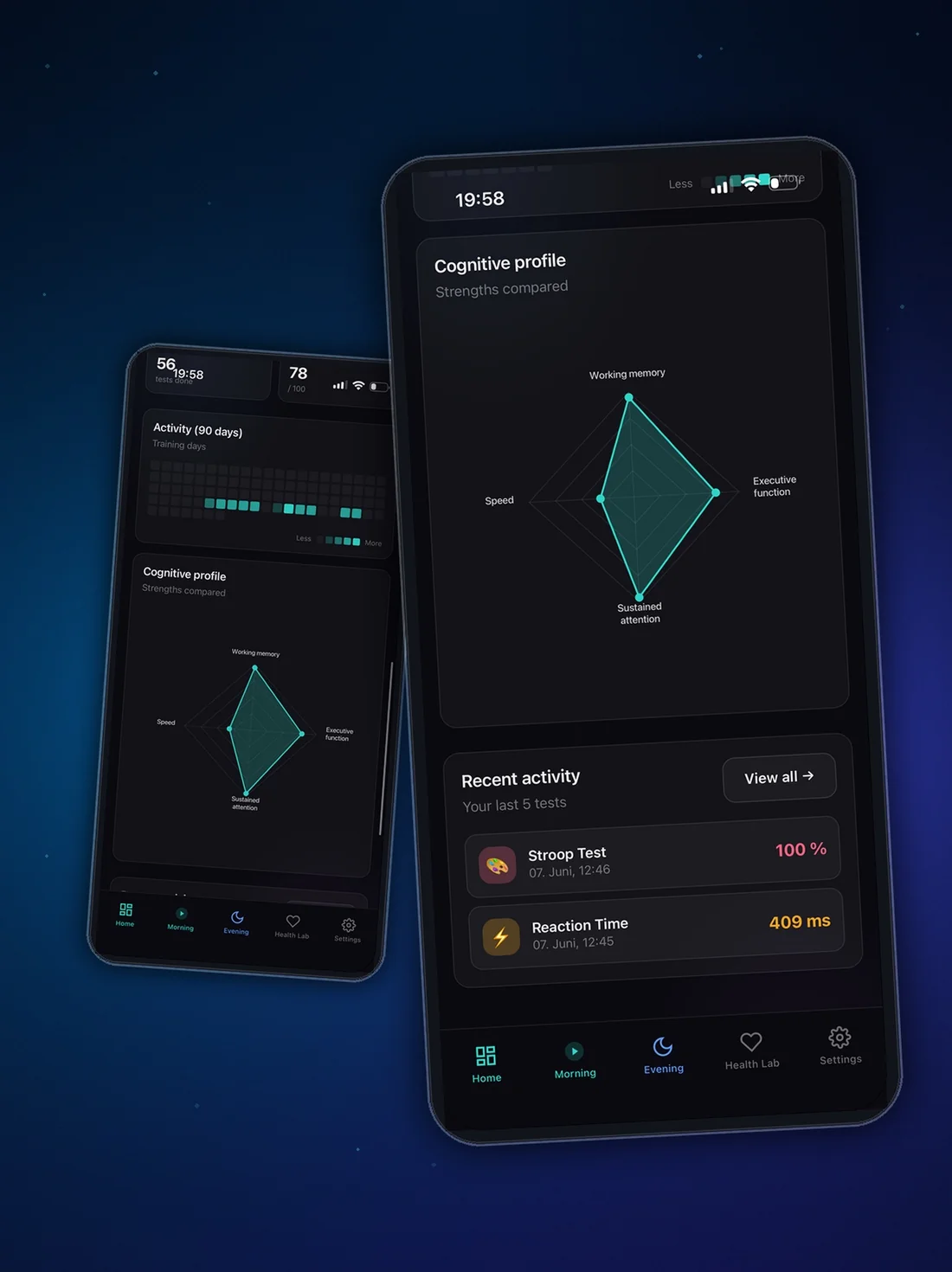
Eight tasks across four domains. Every score is measured against your own baseline, never a leaderboard — and when a task changes, its history is kept separate so the trend can’t quietly lie to you.
Keep things in your head while you work with them.
Ignore the distraction. Don’t hit the wrong button.
Hold attention when nothing interesting is happening.
How quickly you take something in and act on it.
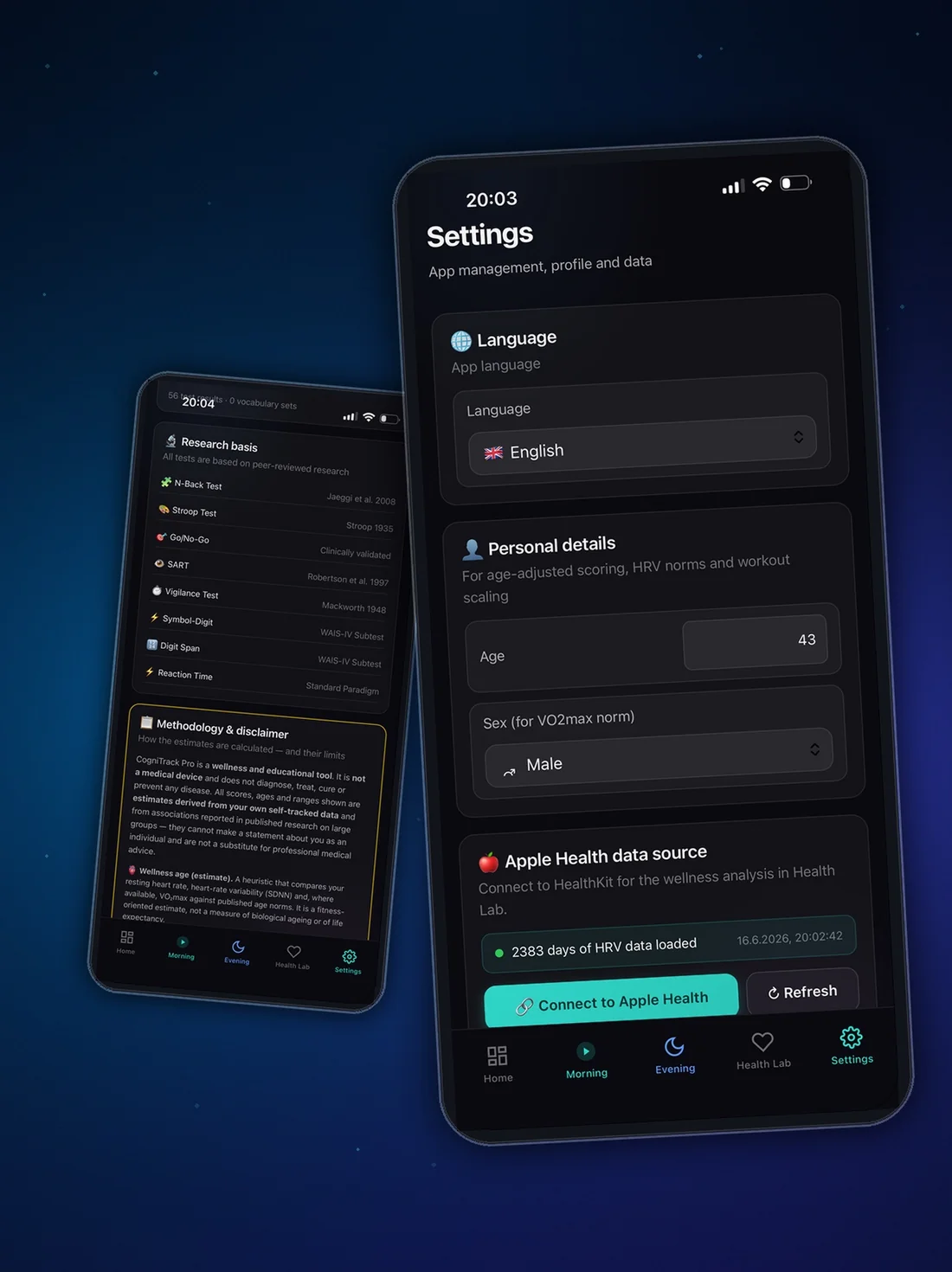
Built on paradigms from cognitive science — N-Back, Stroop, SART and others. Adapted for daily self-tracking, which makes them good at showing your own trend and not a clinical assessment.
Apple Health & Apple Watch
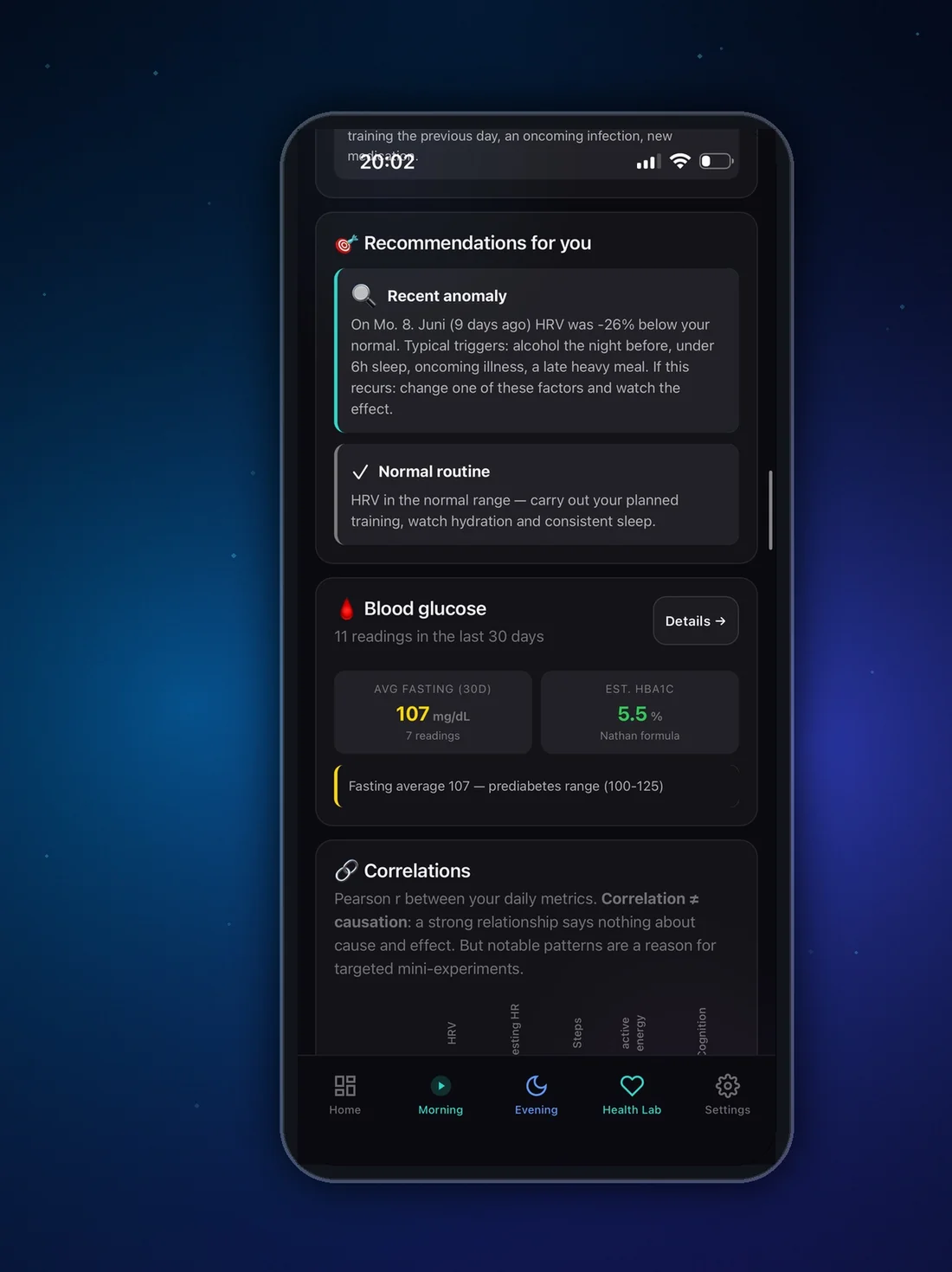
Your watch already records HRV, resting heart rate, sleep and activity. CogniTrack reads them and answers one question: how recovered are you today, compared with your own normal?
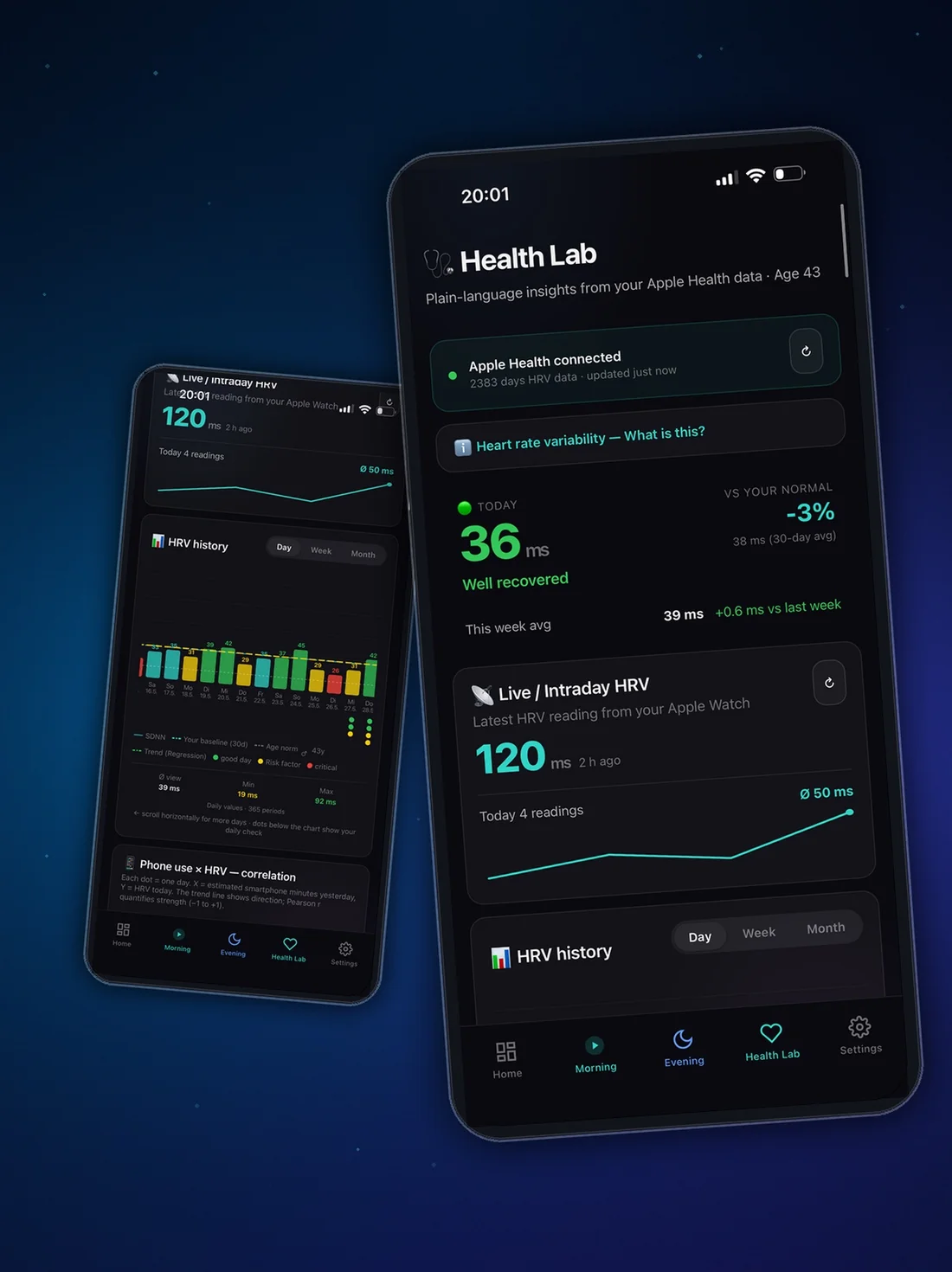
Patterns
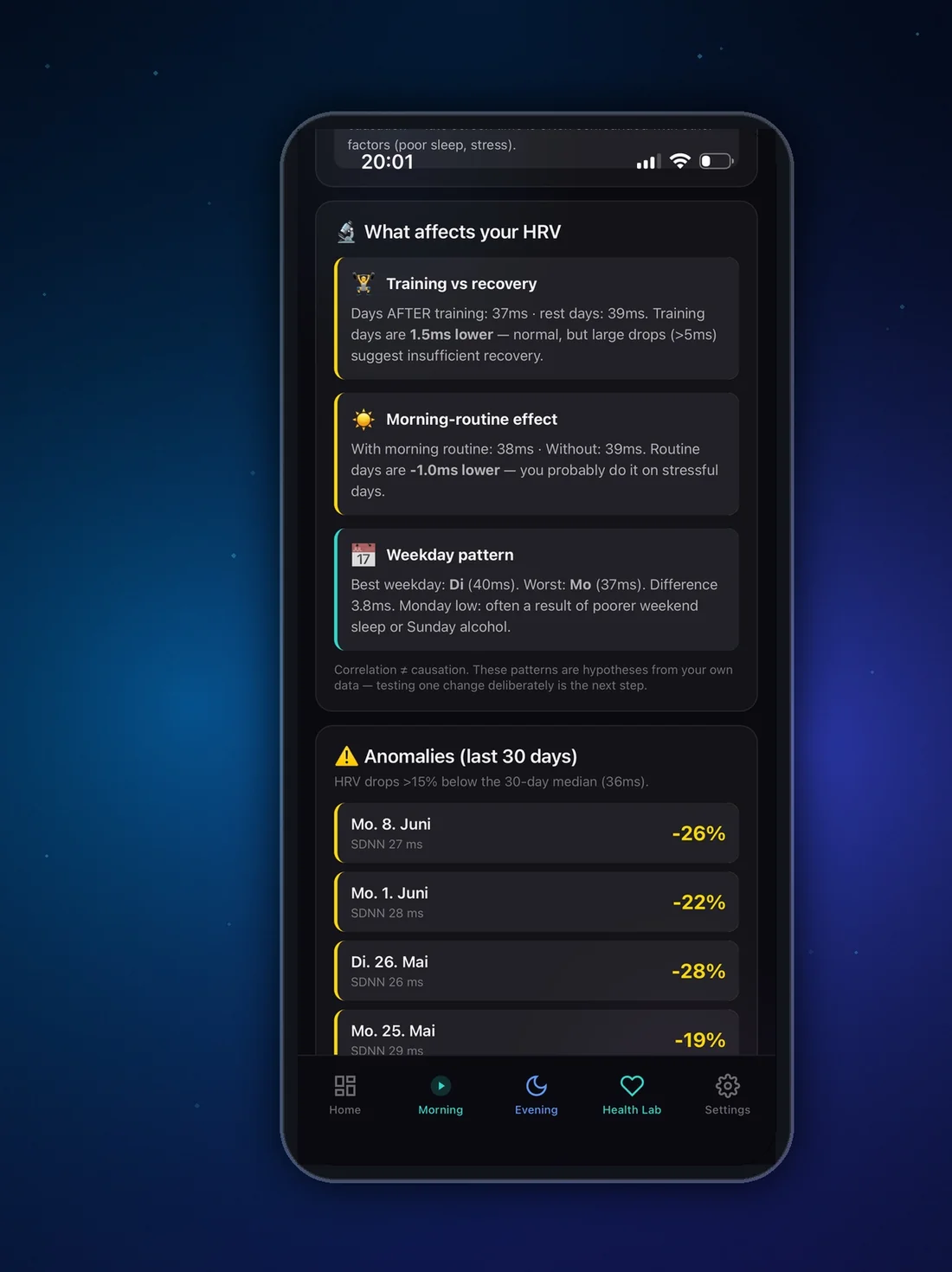
The app looks across routine, cognition and health for things that move together — late nights and slow mornings, long walks and sharp afternoons. It hands them to you as hypotheses, because that is all they are.
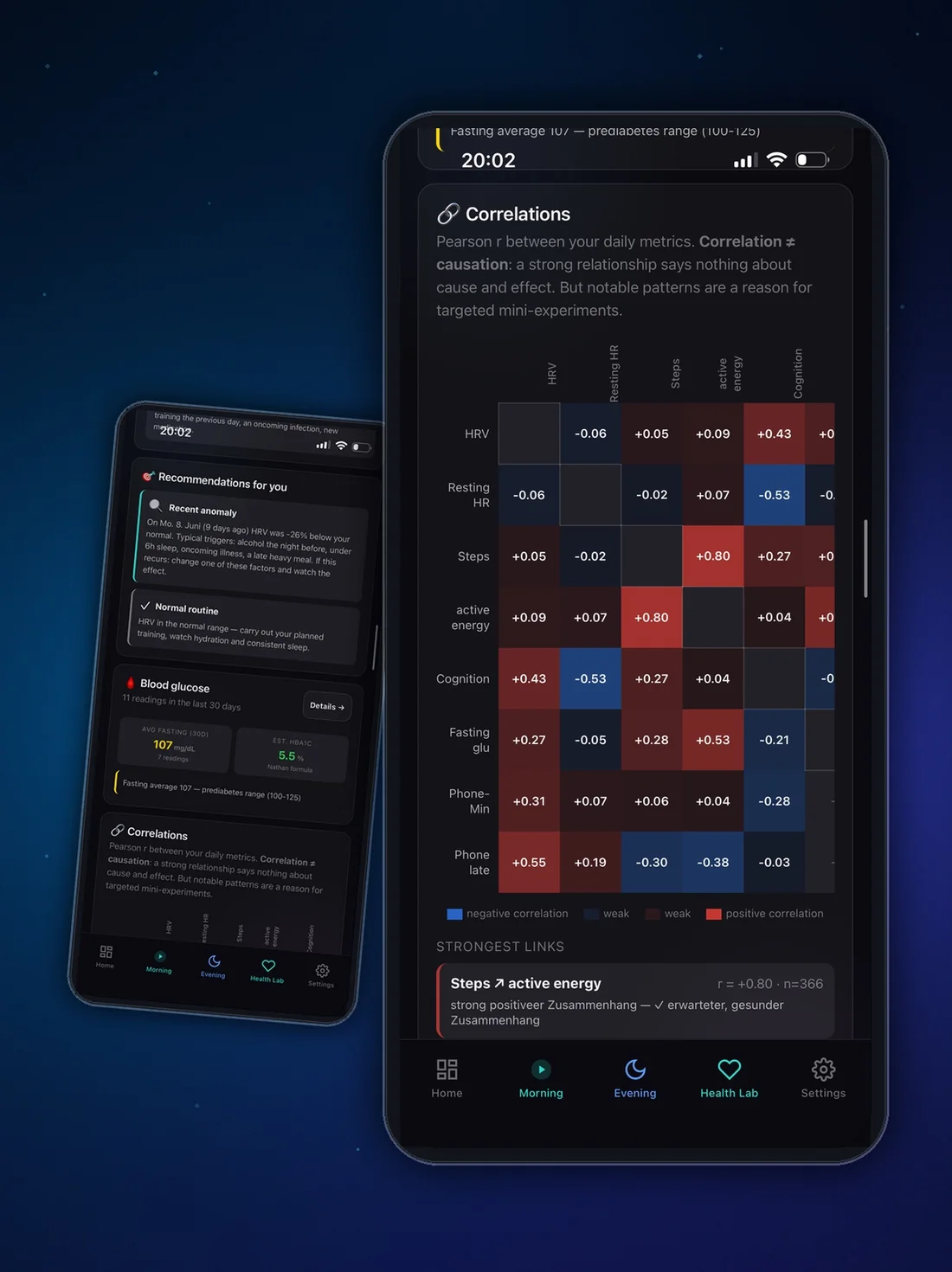
A closer look
Straight out of the app. Labels and routine order keep shifting as the protocol improves.
↔ Scroll to browse
Privacy
No account. No ads. No analytics SDK. No developer cloud. I built this for my own data first, which turns out to be a very good reason to keep it local.
Results, routines and Apple Health insights are stored and computed on your phone.
No third-party analytics, no ad IDs, no data sold. The app ships without third-party SDKs.
A wellness and education tool. It does not diagnose, treat, cure or prevent anything.
Plain-English detail on what the app reads from Apple Health, the optional self-hosted sync, and your rights under GDPR.
The daily loop
Two anchors a day. What happens between them is the experiment.
Morning · ~7 min
Run the fixed core before the day gets loud. Same protocol every time, so the number actually means something.
Through the day
Reaction Time and Digit Span rotate through the morning core. Want a longer session, open the Training tab.
Evening · ≤5 min
Recall, wind down, set tomorrow. Then read the trend next to HRV, sleep and activity.
The DRFRIEDELS ecosystem
Same promise on both sides: less friction, fewer things to carry, better decisions.
Physical multi-tools currently ship to US customers only.
FAQ
No. It is a wellness and education app. It does not diagnose, treat, cure or prevent disease, and it is not a substitute for medical advice. Every score is a personal tracking estimate.
No. Health data is read and processed on your iPhone and is never sent to me or to anyone else. Access needs your explicit permission, and you can revoke it any time in iOS Settings.
Real paradigms, adapted for daily use: N-Back and Digit Span for working memory, Stroop and Go/No-Go for executive function, SART and a vigilance task for sustained attention, Symbol-Digit and Reaction Time for processing speed. Research-informed self-tracking — not clinical instruments.
Because sleep, recovery, stress and activity shape how sharp you are on a given day. Together they explain more than either alone. The app still frames what it finds as a hypothesis, not a cause.
No. The tasks and routines run on iPhone alone. A Watch adds HRV, heart rate, sleep and activity, which makes the recovery and pattern views more useful.
Same idea, different material. DRFRIEDELS builds focused tools that take friction out of a moment. CogniTrack does that for the daily routine.
Build it with me
Two ways in: send one specific proposal, or join the small test-user list.
Bug reports & feedback
Tell me what went wrong, what could be clearer, or what you would like CogniTrack to do next. It lands directly in my admin console — no public board, no ticket queue.
Early test group
Selected pre-release builds and short, specific usability tests. No newsletter, no obligation.